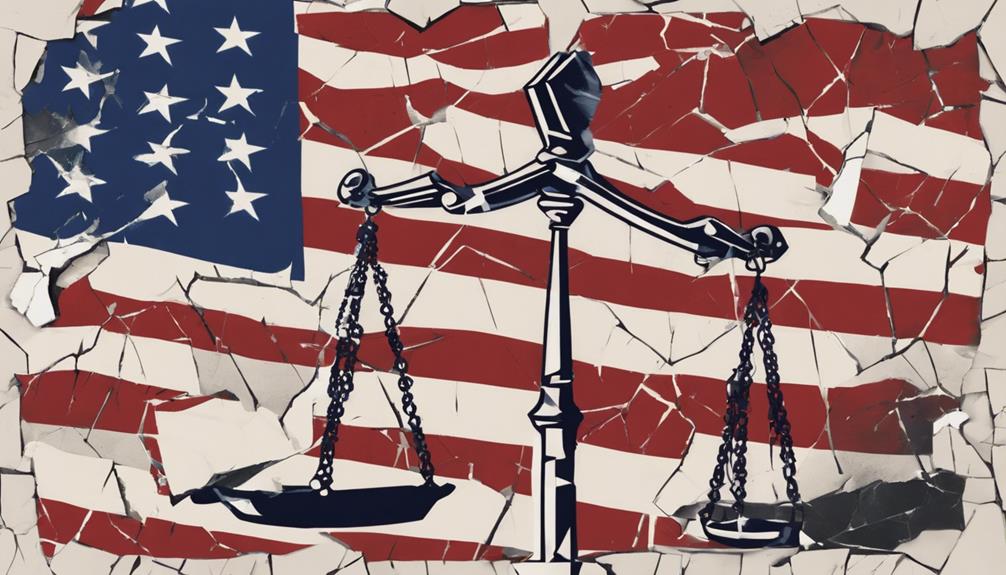
Recent Supreme Court decisions have sent shockwaves throughout the nation, impacting vital aspects of American life. The overturning of Roe v. Wade has sparked widespread concern for women's health and autonomy. Meanwhile, LGBTQ+ individuals face uncertainty as protections are threatened. The court's stance on religious freedom has ignited debate, while pivotal votes are endangered by voter suppression tactics. The court's influence also reverberates in areas like environmental policy, gun control, and corporate power. As the country navigates these landmark decisions, one thing is clear: the implications are far-reaching, and the conversation is only just beginning.
Reproductive Rights in Jeopardy
The recent Supreme Court decision to overturn Roe v. Wade has sent shockwaves throughout the nation, leaving millions of women wondering if their reproductive rights are being systematically dismantled. This landmark decision has far-reaching implications, particularly for women's health and maternal mortality rates. The United States already has one of the highest maternal mortality rates among developed countries, and restrictive abortion laws can exacerbate this issue. According to the Centers for Disease Control and Prevention (CDC), the maternal mortality rate in the US is approximately 17 deaths per 100,000 live births, with disproportionate rates among women of color.
The Supreme Court's decision has also sparked controversy surrounding the concept of fetal personhood. This ideology posits that a fetus has inherent rights and protections under the law, often at the expense of the pregnant person's autonomy. However, this perspective neglects the complex and often fraught circumstances surrounding pregnancy, childbirth, and maternal health. By prioritizing fetal personhood, the state may be prioritizing the life of the fetus over that of the mother, potentially leading to devastating consequences for women's health and well-being.
As the nation grapples with the repercussions of this decision, it is imperative to ponder the far-reaching implications for women's reproductive rights and maternal health outcomes. The Supreme Court's ruling has set a risky precedent, and it is vital that policymakers, healthcare providers, and advocates work together to safeguard that women's autonomy and health are protected.
LGBTQ+ Protections Under Fire
As the Supreme Court's recent decisions continue to reshape the American legal landscape, the LGBTQ+ community finds itself facing unprecedented challenges to its hard-won protections. The Court's conservative shift has sparked concerns that decades of progress may be undone, leaving marginalized individuals vulnerable to discrimination and harassment.
One area of particular concern is workplace harassment, where LGBTQ+ individuals already face disproportionate rates of mistreatment. Recent rulings have weakened protections against discrimination, emboldening employers to act with impunity. This not only perpetuates a hostile work environment but also perpetuates systemic inequality.
The erosion of LGBTQ+ protections is also evident in the world of identity politics. The Court's decisions have emboldened politicians to pursue policies that actively undermine the rights of marginalized communities. By framing LGBTQ+ identity as a political issue rather than a fundamental aspect of human identity, these policies perpetuate harmful stereotypes and stigmatization.
The cumulative effect of these developments is a climate of fear and uncertainty for LGBTQ+ individuals. As the Court continues to reshape the legal landscape, it is essential that policymakers and advocates prioritize the protection of LGBTQ+ rights. By doing so, we can make sure that the progress made in recent decades is not lost, and that all individuals are treated with dignity and respect.
Rethinking Gun Control Laws
Following a decade marked by devastating mass shootings and escalating gun violence, a national reckoning on gun control has become increasingly urgent. The recent Supreme Court decisions have sparked a renewed debate on the interpretation of the Second Amendment and its implications on gun control laws. As gun violence continues to claim innocent lives, it is essential to reexamine the balance between the right to bear arms and the need for stricter regulations.
The Second Amendment, often cited as a justification for lax gun control, has been interpreted by some as an unconditional guarantee of gun ownership. However, in the face of rampant gun violence, it is vital to reassess this stance. The Supreme Court's recent decisions have opened the door for a more nuanced discussion on gun control, one that acknowledges the need for responsible gun ownership while also addressing the epidemic of gun violence.
The consequences of inaction are stark: continued gun violence, more lives lost, and a perpetual sense of fear and uncertainty. It is imperative that policymakers, lawmakers, and citizens engage in a constructive dialogue to find common ground on gun control. This includes exploring measures such as universal background checks, red flag laws, and assault weapon bans. By rethinking gun control laws, we can work towards a safer, more responsible, and more compassionate society. The time for change is now; the lives lost to gun violence demand it.
Redistricting and Gerrymandering
Silent manipulation of electoral boundaries has become a hallmark of American politics, with gerrymandering and redistricting tactics perpetuating a vicious cycle of partisan gridlock and democratic disillusionment. The Supreme Court's recent decisions have sparked intense debate around the role of gerrymandering in shaping electoral outcomes. By allowing political parties to redraw district boundaries for partisan gain, gerrymandering perpetuates boundary disputes and electoral manipulation, undermining representative fairness.
This phenomenon has far-reaching implications, contributing to voter suppression and geographic bias in the electoral process. By manipulating district boundaries, politicians can disenfranchise certain voter groups, limiting their political influence. District reform efforts have been hindered by partisan interests, allowing gerrymandering to persist as a major obstacle to democratic accountability.
The Supreme Court's inaction on this issue has emboldened partisan actors, perpetuating a cycle of electoral manipulation. In the absence of meaningful reform, partisan gridlock and democratic disillusionment will continue to plague American politics. It is imperative that policymakers prioritize district reform, prioritizing geographic fairness and representative accountability over partisan interests. By addressing the root causes of gerrymandering, we can reclaim the integrity of our electoral process and restore faith in American democracy.
Free Speech in the Digital Age
The intersection of free speech and the digital age has given rise to complex questions about the role of online platforms in regulating content. A pressing concern is the extent to which these platforms should be held liable for the speech they host, and whether government regulation is necessary to guarantee accountability. As the Supreme Court continues to weigh in on these issues, the boundaries of free speech in the digital era remain in flux.
Online Platforms' Liability
Online platforms, once hailed as champions of free speech, are now grappling with the consequences of their own unbridled growth, as the Supreme Court's recent decisions have sparked a heated debate about their liability for user-generated content. The lines between free speech and harmful content have become increasingly blurred, prompting calls for stricter content moderation practices.
| Aspect | Impact |
|---|---|
| Content Moderation | Balancing free speech with removing harmful content |
| Algorithmic Transparency | Accountability for amplifying harmful content |
| User Autonomy | Freedom to express oneself versus protection from harm |
| Platform Liability | Accountability for user-generated content |
As online platforms navigate this complex landscape, they must prioritize content moderation and algorithmic transparency to safeguard a safe and inclusive environment for users. By doing so, they can mitigate the spread of harmful content and maintain their role as champions of free speech. Ultimately, finding a balance between free expression and responsible content governance is essential for the future of online discourse.
Government Regulation Needed
Amidst the ongoing struggle to define the boundaries of free speech in the digital age, a growing chorus of voices is calling for government regulation to guarantee that online platforms do not become breeding grounds for harmful content. The need for regulation is underscored by the lack of industry standards, which has led to the proliferation of misinformation, hate speech, and other harmful content. Government regulation can provide environmental safeguards, establishing that online platforms prioritize public well-being and consumer protection. Additionally, economic oversight can prevent the concentration of power and promote fair competition. Public accountability mechanisms can also be established to make sure that online platforms are transparent and responsive to public concerns. By implementing industry standards and regulations, governments can create a safer and more responsible online environment. This, in turn, can foster a more informed and engaged citizenry, which is essential for a healthy democracy. Ultimately, government regulation is necessary to guarantee that the digital age is characterized by freedom of expression, rather than freedom to harm.
Immigration Reform in Limbo
Scalping the edges of partisan divisions, the Supreme Court's recent decisions have further muddied the already turbulent waters of immigration reform. The consequences of these decisions have left the immigration system in limbo, causing uncertainty for millions of individuals and families. The Court's rulings have significant implications for various aspects of immigration policy, including border security, immigration pathways, and visa overhaul.
| Aspect of Immigration Policy | Current Status | Stakeholders' Concerns |
|---|---|---|
| Border Security | In flux, with debates surrounding border walls and migrant detention | Humanitarian concerns, national security, and economic impact |
| Immigration Pathways | Uncertainty around legalization programs and visa allocation | Migrant rights, family reunification, and labor market needs |
| Asylum Crisis | Backlog of asylum claims, with concerns around deportation policy and refugee quotas | Human rights, international obligations, and humanitarian responsibilities |
The asylum crisis, in particular, has sparked intense debates around deportation policy and refugee quotas. The Supreme Court's decisions have also raised questions about the future of immigration pathways, including legalization programs and visa allocation. As the immigration system teeters on the brink of chaos, stakeholders are left wondering about the fate of migrant rights, border security, and the nation's humanitarian obligations. The uncertainty surrounding immigration reform has far-reaching consequences, and it is essential to navigate these complex issues to find a way forward.
The Future of Affirmative Action
The Supreme Court's recent rulings have significant implications for the future of affirmative action, particularly in the domain of college admissions policies. As the Court's decisions continue to shape the landscape of racial diversity in schools, it is essential to examine the consequences of these rulings on the educational landscape. In this scenario, the fate of affirmative action hangs in the balance, as institutions and policymakers navigate the complexities of promoting diversity while adhering to the law.
College Admissions Policies
Shifting legal landscapes have prompted universities to reexamine their admissions policies, as the future of affirmative action hangs in the balance. The debate surrounding college admissions policies has sparked intense discussion on meritocracy debates and legacy preferences. As universities navigate the complexities of creating diverse and inclusive student bodies, they must also confront the implications of recent Supreme Court decisions.
| Admissions Policy | Impact on Diversity |
|---|---|
| Race-neutral policies | Decreased diversity |
| Legacy preferences | Favors affluent applicants |
| Holistic review | Increased diversity |
| Merit-based admissions | Favors high-achieving students |
| Need-blind admissions | Increased diversity |
The table above illustrates the potential impact of different admissions policies on diversity. As universities adapt to the shifting legal landscape, they must carefully consider the implications of their policies on student body diversity. By reexamining their admissions policies, universities can work towards creating more inclusive and equitable environments.
Racial Diversity in Schools
Racial diversity in schools hangs precariously in the balance as the Supreme Court's recent decisions cast uncertainty over the future of affirmative action, prompting educators and policymakers to reevaluate their strategies for promoting inclusivity. As the education landscape shifts, it is crucial to prioritize culturally responsive practices that foster a sense of belonging among diverse student populations. This can be achieved by promoting teacher diversity, which has been shown to have a positive impact on student outcomes, particularly for students of color.
To move forward, educators must abandon a one-size-fits-all approach and instead adopt tailored strategies that acknowledge the unique experiences and perspectives of diverse student groups. This may involve revising curricula to incorporate diverse perspectives, providing professional development opportunities for teachers to enhance their cultural competence, and creating safe spaces for students to share their experiences.
Ultimately, the future of affirmative action hangs in the balance, and it is vital that educators and policymakers collaborate to guarantee that our schools remain inclusive and equitable environments that prepare students for success in an increasingly diverse society.
Climate Change and Government Inaction
Nearly a decade has passed since the Supreme Court's landmark ruling in Massachusetts v. EPA, which mandated the Environmental Protection Agency to regulate greenhouse gas emissions, yet federal efforts to combat climate change remain stalled. The lack of progress is alarming, and the consequences of inaction are far-reaching. The Supreme Court's decision was a pivotal step towards climate accountability, but it seems that the government has failed to take meaningful action.
The consequences of climate change are undeniable, from devastating natural disasters to unpredictable weather patterns. It is imperative that the government takes a proactive approach to mitigate its effects. Environmental leadership is vital in this fight, and the current state of inaction is unacceptable.
To move forward, the government must:
- Recommit to the Paris Agreement: The US must rejoin the global effort to reduce greenhouse gas emissions and limit global warming to 1.5°C above pre-industrial levels.
- Invest in Renewable Energy: Shifting to renewable energy sources, such as wind and solar power, is essential to reducing our reliance on fossil fuels.
- Enact Climate-Resilient Infrastructure: Investing in climate-resilient infrastructure, such as sea walls and green roofs, will help protect communities from the impacts of climate change.
The Supreme Court's decision in Massachusetts v. EPA was a pivotal step towards climate accountability, but it is only the first step. It is time for the government to take bold action to combat climate change and guarantee a sustainable future for generations to come.
Religious Freedom Vs. Discrimination
The tension between religious freedom and discrimination has reached a boiling point, as recent Supreme Court decisions have sparked controversy and debate about the boundaries of religious liberty and the protection of individual rights. At the heart of this conflict lies the question of where to draw the line between the free exercise of faith practices and the prohibition of discriminatory acts. The Court's rulings have been met with both applause and criticism, as some argue that religious freedom is being used as a guise for discrimination, while others contend that their moral obligations are being safeguarded.
The debate surrounding religious freedom and discrimination has far-reaching implications, as it touches on the very fabric of American society. The Supreme Court's decisions have significant consequences for individuals, businesses, and communities, as they navigate the complex landscape of faith practices, moral obligations, and individual rights. The Court's role in balancing these competing interests is vital, as it must ensure that the rights of all individuals are protected, while also respecting the deeply held beliefs of religious individuals and organizations.
Ultimately, the Supreme Court's decisions on religious freedom and discrimination will have a profound impact on the social and cultural fabric of the United States. As the nation continues to grapple with these complex issues, it is essential that we engage in thoughtful and respectful dialogue, recognizing the inherent value of both religious liberty and individual rights. By doing so, we can work towards a more just and equitable society, where all individuals are treated with dignity and respect.
The Erosion of Voter Rights
In an era marked by growing political polarization, the Supreme Court's decisions have greatly impacted the voting rights landscape, sparking intense debate about the balance between electoral integrity and voter access. The Court's recent rulings have emboldened efforts to restrict voting rights, undermining the fundamental principles of democracy.
The erosion of voter rights is a pressing concern, as it disproportionately affects marginalized communities. Voter suppression tactics, such as voter ID laws and restrictions on early voting, have been upheld by the Court, further entrenching existing inequalities. These measures, touted as necessary for election integrity, have been criticized for disenfranchising eligible voters and undermining the democratic process.
Key developments in the erosion of voter rights include:
- Weakening of the Voting Rights Act: The Court's 2013 decision in Shelby County v. Holder gutted an essential provision of the Voting Rights Act, allowing states to change their voting laws without federal oversight.
- Voter ID laws: The Court has upheld voter ID laws, which have been criticized for disproportionately affecting minority and low-income voters.
- Voting restrictions: The Court has allowed states to impose restrictions on early voting, same-day registration, and out-of-precinct voting, further limiting voter access.
As the Supreme Court continues to shape the voting rights landscape, it is essential to recognize the far-reaching implications of its decisions on the democratic process and the fundamental right to vote.
Corporate Power and Campaign Finance
Beyond the domain of voter rights, the Supreme Court's decisions have also reshaped the landscape of corporate power and campaign finance, granting unprecedented influence to wealthy donors and special interest groups. The Citizens United ruling, in particular, has enabled the flow of Dark Money into political campaigns, obscuring the sources of funding and undermining Financial Transparency. This lack of transparency has led to a lack of Corporate Accountability, as companies can now anonymously influence political decisions without fear of reprisal.
The increased Political Influence of wealthy donors has also led to calls for Lobbyist Reform, as special interest groups wield significant power in shaping policy. Meanwhile, Campaign Reform efforts have stalled, as the influx of Dark Money has made it difficult to track Donor Disclosure. This erosion of Election Integrity has far-reaching consequences, as the voices of ordinary citizens are drowned out by the wealthy elite.
To address these concerns, advocates are pushing for greater transparency in campaign financing, including stricter disclosure requirements and limits on corporate spending. By promoting Financial Transparency and Corporate Accountability, we can reclaim our democracy from the grip of special interest groups and restore the integrity of our electoral process. Ultimately, the health of our democracy depends on our ability to regulate the influence of money in politics and ensure that all voices are heard, not just those with the deepest pockets. This effort aligns with broader discussions about fairness and influence, especially as personalization in modern marketing shapes public perception and voter behavior. The same data-driven techniques used to tailor advertisements can also be leveraged to manipulate political messaging, further emphasizing the need for transparency. By addressing both financial and digital influence, we can create a more equitable system that prioritizes informed decision-making over targeted persuasion.
The Struggle for Racial Justice
The struggle for racial justice has been greatly influenced by recent Supreme Court decisions, which have had a profound impact on the lives of marginalized communities. Two critical areas where the Court's rulings have fallen short are racial bias in policing and systemic racism in the courts, perpetuating a cycle of discrimination and injustice. As we examine the Court's decisions, it becomes clear that these issues are intertwined and demand a holistic approach to address the deep-seated inequalities that persist in our society.
Racial Bias in Policing
Pervasive racial bias in policing has spawned a plethora of high-profile cases, galvanizing a national conversation about systemic racism and police brutality. The issue is complex, multifaceted, and deeply entrenched, perpetuating a cycle of mistrust and violence between law enforcement and communities of color.
The consequences of racial bias in policing are far-reaching and devastating. For instance:
- Racial profiling: The disproportionate targeting of people of color for stops, searches, and arrests has led to a disproportionate representation of minorities on crime statistics, perpetuating negative stereotypes and further entrenching racial bias.
- Police brutality: The use of excessive force against people of color has resulted in numerous fatalities, sparking widespread protests and calls for reform.
- Erosion of trust: The perpetuation of racial bias has led to a breakdown in trust between law enforcement and the communities they serve, undermining the very fabric of our society.
Ultimately, addressing racial bias in policing is vital to restoring trust, promoting justice, and ensuring equal protection under the law for all citizens.
Systemic Racism in Courts
Racial bias in policing is only one facet of a broader issue, as systemic racism also permeates the court system, where discriminatory practices and biases can have devastating consequences for communities of color. The struggle for racial justice is not limited to law enforcement, but also extends to the very institutions designed to uphold justice. Court bias is a pervasive problem, with racial disparities evident in everything from sentencing to jury selection. Studies have consistently shown that people of color are more likely to be wrongly convicted, receive harsher sentences, and face discrimination in the courtroom. These racial disparities are not only unjust but also perpetuate a cycle of inequality, further entrenching systemic racism. The impact of court bias is profound, eroding trust in the legal system and perpetuating cycles of inequality. To achieve true justice, it is essential to address the deep-seated biases that permeate our court system, working towards a more equitable and just system for all.
Frequently Asked Questions
What Happens to Existing Laws if a Supreme Court Justice Resigns?
When a Supreme Court Justice resigns, a vacancy crisis may ensue, potentially disrupting the Court's functionality. However, existing laws remain unaffected, as the Supreme Court's decisions are not voided by a single Justice's departure. The Judicial Legacy of the departed Justice also remains intact, as their prior rulings and opinions remain binding precedent. The Court's continuity is guaranteed, and the new Justice will build upon the existing legal framework, rather than re-litigating previous decisions.
Can Supreme Court Decisions Be Overturned by Congress?
As the judicial pendulum swings, the question arises: can Congress overturn Supreme Court decisions? The answer lies in the delicate balance of power. While Congress cannot directly overturn a Supreme Court ruling, it can exercise Legislative Checks by passing new laws that supersede or modify existing ones. However, Congress must operate within Constitutional Limits, respecting the Court's authority while exercising its own. This nuanced interplay guarantees a system of checks and balances, safeguarding the nation's democratic fabric.
How Do Supreme Court Decisions Impact State and Local Laws?
Supreme Court decisions greatly influence state and local laws, often setting national precedent. Local enforcement agencies must adapt to these rulings, as they become the standard for law enforcement practices. State precedent is also shaped by these decisions, guiding judicial interpretations and informing legislative actions. This trickle-down effect guarantees that Supreme Court decisions have far-reaching implications, shaping the legal landscape at both state and local levels.
Are Supreme Court Justices Accountable to Anyone for Their Decisions?
In the esteemed domain of the judiciary, an essential inquiry emerges: are Supreme Court justices accountable to anyone for their decisions? While they wield immense power, justices are not entirely unbridled. They are bound by Judicial Ethics, ensuring their impartiality and integrity. Ultimately, their accountability lies with the public, as they must maintain the trust of the people they serve. The preservation of Public Trust is paramount, as it is the cornerstone of a healthy democracy.
Can the Supreme Court Declare a Law Unconstitutional Retroactively?
The Supreme Court's power of Judicial Review enables it to declare a law unconstitutional, but can it do so retroactively? The answer lies in the Constitutional Limits of the Court's authority. While the Court can strike down a law, its ruling generally applies prospectively, not retroactively. This guarantees that individuals and institutions are not unfairly penalized for complying with a law later deemed unconstitutional, maintaining a balance between the rule of law and fairness.