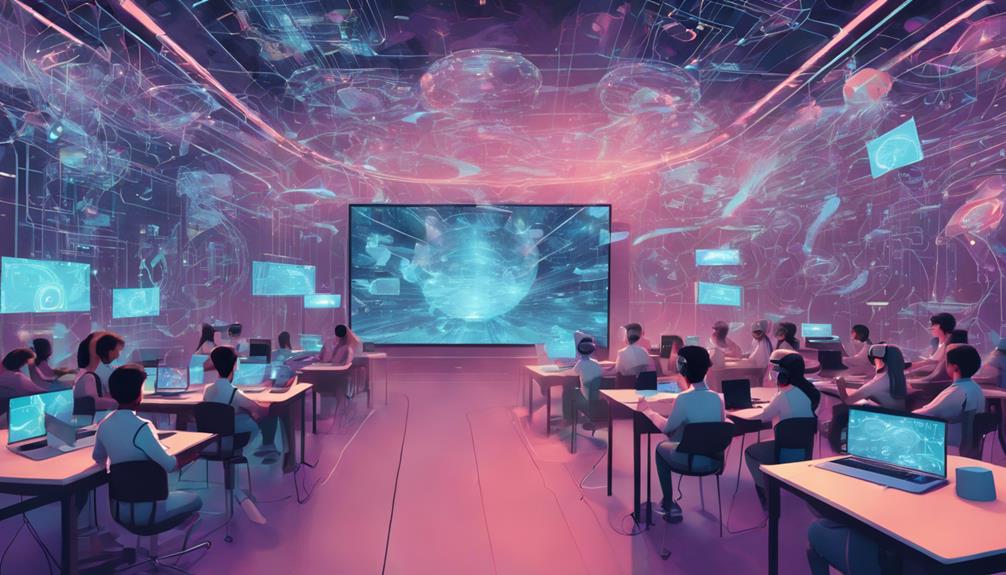
Technology is revolutionizing education by creating digital classrooms that foster immersive, interactive, and personalized learning experiences. AI-driven systems provide tailored instruction, while data analytics track student progress, and virtual field trips simulate real-world environments. Gamification boosts engagement, and inclusive design enables accessible learning for all. Online platforms facilitate communication across geographical barriers, and scalable infrastructure supports collaboration. As educators and policymakers continue to harness the power of technology, the future of education is shaping up to be more innovative, inclusive, and effective. And there's still more to explore in this rapidly evolving landscape.
Digital Classrooms of the Future
As educators and policymakers envision the digital classrooms of the future, they’re increasingly incorporating immersive technologies, artificial intelligence, and data analytics to create personalized learning experiences that cater to diverse learning styles and abilities. By leveraging these innovative tools, they’re redefining the traditional classroom, making it more engaging, interactive, and student-centered. These advancements not only enhance student engagement but also foster critical thinking and creativity by providing dynamic, real-world applications of knowledge. A key aspect of this transformation is how technology shapes storytelling, allowing students to explore narratives through virtual reality, interactive simulations, and adaptive digital content. As a result, education is becoming more immersive and responsive, empowering learners to take an active role in their own academic journeys.
A robust digital infrastructure is essential to support this vision. It involves investing in high-speed internet, devices, and software that enable seamless connectivity and access to digital resources. Additionally, it requires a scalable and flexible infrastructure that can accommodate the growing needs of students, teachers, and administrators. This infrastructure should facilitate seamless communication, collaboration, and knowledge sharing among stakeholders.
Effective teacher training is also critical to the success of digital classrooms. Teachers need professional development opportunities to acquire the necessary skills to integrate technology into their teaching practices. They should be equipped to design engaging digital lessons, utilize AI-powered tools, and analyze data to inform instruction. By upskilling teachers, educators can ensure a smooth shift to digital classrooms and maximize the benefits of technology in education.
Breaking Down Geographical Barriers
Technological advancements are bridging geographical divides, enabling students from diverse locations to access quality education and connect with peers worldwide. This breakdown of geographical barriers has opened up unprecedented opportunities for cultural exchange and collaboration. Students can now engage with peers from different cultural backgrounds, fostering global understanding and empathy.
- Online platforms facilitate language bridges, allowing students to communicate and learn from one another despite language barriers.
- Virtual exchange programs enable students to participate in cultural immersion experiences, broadening their perspectives and understanding of global issues.
- Digital classrooms provide access to high-quality educational resources, bridging the gap between developed and developing countries.
As a result, students are no longer limited by their geographical location, and can now access education that was previously inaccessible. This shift has far-reaching implications, as it enables students to develop a more nuanced understanding of the world and its complexities. By breaking down geographical barriers, technology is creating a more interconnected and collaborative global community. As education becomes increasingly globalized, students are poised to become active participants in shaping a more harmonious and equitable world.
Personalized Learning With AI
As technology continues to shape the education landscape, AI-powered tools are revolutionizing the way students learn. By leveraging Intelligent Tutoring Systems and Adaptive Learning Paths, educators can now craft tailored learning experiences that cater to each student's unique needs and abilities. This personalized approach has the potential to greatly enhance student outcomes and bridge the gap between struggling and thriving learners.
Intelligent Tutoring Systems
Intelligent tutoring systems, powered by artificial intelligence, are revolutionizing the way students learn by providing personalized instruction tailored to their unique needs and abilities. These systems mimic the one-on-one support of a human tutor, but with the scalability and efficiency of technology. By leveraging AI-driven algorithms, intelligent tutoring systems can analyze a student's strengths, weaknesses, and learning style to create a customized learning experience.
Some key features of intelligent tutoring systems include:
- Knowledge Graphs: AI-powered knowledge graphs map a student's knowledge and skills, identifying areas of strength and weakness to inform personalized instruction.
- Human Emulation: Intelligent tutoring systems use human emulation to simulate the one-on-one support of a human tutor, providing real-time feedback and guidance.
- Real-time Adaptation: These systems continuously assess student performance, adapting instruction to meet the student's changing needs and abilities.
Adaptive Learning Paths
Adaptive learning paths, fueled by AI, empower educators to facilitate personalized learning journeys that adjust in real-time to a student's evolving skills and knowledge. This innovative approach leverages Learning Analytics to continuously assess student progress, identifying strengths and weaknesses, and adjusting the curriculum accordingly. By establishing a unique Student Profiling system, educators can tailor learning experiences to individual needs, ensuring that each student stays engaged and motivated.
| Benefit | Description |
|---|---|
| Personalized Learning | AI-driven adaptive learning paths customize education to individual students' needs |
| Real-time Feedback | Continuous assessment provides immediate feedback, enabling data-driven instruction |
| Efficient Resource Allocation | Educators can focus on areas where students need additional support |
| Enhanced Engagement | Students stay motivated, as learning experiences are customized to their interests and abilities |
Through adaptive learning paths, educators can harness the full potential of their students, fostering a more effective and efficient learning environment. By leveraging the power of AI, educators can create a truly personalized learning experience, redefining the future of education.
Virtual Field Trips and Exploration
Virtual field trips and exploration are revolutionizing the way students learn by providing access to environments that may be difficult or impossible to visit in person. Through virtual exploration, students can explore new environments that were previously inaccessible, such as historical sites, natural wonders, or even outer space. By using technology to facilitate these experiences, students can engage in immersive learning experiences that simulate real-world exploration.
Exploring New Environments
By utilizing technology, students can engage in immersive virtual field trips that simulate real-world environments, fostering deeper understanding and engagement. This innovative approach enables students to explore virtual landscapes that may be difficult or impossible to visit in person. Through interactive simulations, students can interact with virtual environments in a highly engaging and immersive way.
Some examples of these virtual environments include:
- Virtual museum tours: Students can explore exhibits and artifacts from around the world, interacting with virtual displays and learning about different cultures and historical periods.
- Virtual labs: Students can conduct experiments and investigations in a virtual lab setting, reducing costs and minimizing risks associated with traditional lab work.
- Virtual historical sites: Students can explore historical sites and landmarks, such as ancient civilizations or historical events, in a highly immersive and interactive way.
These virtual environments have the potential to revolutionize the way we learn, making education more accessible, engaging, and effective. By leveraging technology, educators can create immersive and interactive learning experiences that inspire students and foster a deeper understanding of complex concepts.
Immersive Learning Experiences
Through immersive learning experiences, students can participate in virtual field trips that not only simulate real-world environments but also provide a sense of presence and agency, allowing them to explore and interact with virtual landscapes in a highly engaging and memorable way. These experiences can be particularly important in subjects like science, technology, engineering, and math (STEM), where hands-on experimentation is essential. Virtual labs, for instance, enable students to conduct experiments and gather data in a controlled virtual environment, reducing costs and minimizing risks. Interactive simulations, on the other hand, allow students to explore complex concepts in a more engaging and interactive way. By leveraging immersive learning experiences, educators can create a more dynamic and participatory learning environment, increasing student engagement and motivation. Additionally, these experiences can be tailored to individual learning needs, providing a more personalized and effective learning experience. As technology continues to evolve, the potential for immersive learning experiences to revolutionize education is vast.
Gamification in Education
Educators are increasingly incorporating game design and mechanics into their teaching practices, leveraging the psychological appeal of rewards and competition to boost student engagement and motivation. By harnessing the power of gamification, teachers can create immersive and interactive learning experiences that captivate students' attention and encourage active participation. This innovative approach has been shown to improve learning outcomes, increase student satisfaction, and foster a sense of community in the classroom.
Gamification in education involves the strategic use of game elements, such as:
- Reward Systems: Points, badges, and leaderboards that recognize and reward student achievements, motivating them to excel.
- Interactive Quizzes: Engaging, game-like assessments that make learning fun and competitive, providing instant feedback and encouraging healthy competition.
- Virtual Challenges: Immersive, scenario-based learning experiences that simulate real-world problems, encouraging critical thinking, creativity, and problem-solving skills.
Accessible Learning for All
Technology has democratized access to education, empowering students with disabilities to engage fully with learning materials and participate actively in the classroom. This shift towards inclusive education is largely attributed to the integration of technology in learning environments. With digital tools and platforms, educators can create personalized learning experiences tailored to individual needs, ensuring equal opportunities for all students.
Inclusive design is at the forefront of this movement, as education technology providers prioritize accessibility features in their products. From text-to-speech functionality to adjustable font sizes, these features enable students with disabilities to engage with learning materials in a way that was previously impossible. Additionally, digital resources can be easily translated, making education more accessible to students from diverse linguistic backgrounds.
The impact of accessible learning is profound, as students with disabilities can now participate fully in classroom discussions and activities. This, in turn, fosters a more inclusive and diverse learning environment, where every student has an equal opportunity to succeed. By leveraging technology, educators can break down barriers to education, providing students with disabilities the support they need to thrive. As a result, the future of education looks brighter than ever, with technology playing a crucial role in creating a more inclusive and equitable learning environment.
The Rise of Online Learning Platforms
As online access continues to spread globally, opportunities for students to engage in flexible and personalized learning experiences have skyrocketed, paving the way for the widespread adoption of online learning platforms. These platforms have revolutionized the way students learn, offering a range of benefits that traditional classroom settings often can't match.
One of the most significant advantages of online learning platforms is their ability to reduce costs associated with traditional education. For instance:
- Cost savings: Online courses eliminate the need for physical infrastructure, transportation, and accommodation, resulting in significant cost savings for students and institutions alike.
- Increased accessibility: Online learning platforms can reach students in remote or underserved areas, providing equal access to quality education regardless of geographical location.
- Personalized learning: Online platforms can offer tailored learning experiences, allowing students to learn at their own pace and focus on specific areas of improvement.
Despite these benefits, some critics argue that online learning platforms can lead to social isolation. While this is a valid concern, many platforms are now incorporating social features, such as virtual discussion forums and live chats, to foster a sense of community and connection among students. As online learning continues to evolve, it's likely that these platforms will play an increasingly important role in shaping the future of education.
Data Analytics in Education
By leveraging the power of data analytics, educators can now uncover hidden patterns and trends in student performance, pinpointing areas where individualized support is needed. This shift towards data-driven decision making is revolutionizing the way educators approach teaching and learning. With advanced analytics tools, teachers can track student progress in real-time, identifying knowledge gaps and adjusting their instructional strategies accordingly.
Data analytics in education provides educators with valuable educational insights, enabling them to develop targeted interventions and improve student outcomes. By analyzing learning patterns, educators can identify early warning signs of struggling students, providing timely support to get them back on track. This proactive approach helps to reduce the achievement gap and promote academic success for all students.
Moreover, data analytics enables educators to assess the effectiveness of their instructional methods, refining their teaching practices to better meet the needs of their students. By harnessing the power of data, educators can create personalized learning pathways, tailoring their instruction to meet the unique needs of each student. As a result, students receive a more effective and engaging learning experience, leading to improved academic achievement and lifelong success.
Frequently Asked Questions
How Will Digital Classrooms Address Issues of Unequal Access to Technology?
She acknowledges that device disparities and varying levels of tech literacy pose significant barriers to equal access in digital classrooms. To address this, she suggests implementing device-lending programs and providing targeted training to bridge the tech literacy gap. By doing so, educators can guarantee that all students, regardless of their background, have the tools and skills needed to thrive in digital learning environments.
Can Ai-Based Learning Systems Replace Human Teachers Entirely?
Like the mythical phoenix, AI-based learning systems rise from the ashes of traditional education, promising to replace human teachers entirely. But can they truly replicate the essence of teaching? Unlikely, for it's the human connection that sparks curiosity and creativity. AI may excel in data analysis, but it's the teacher's autonomy that fosters critical thinking and empathy. As we navigate this technological renaissance, let's not forget that education is as much about heart as it is about head.
Are Virtual Field Trips as Effective as In-Person Experiences?
Virtual field trips are gaining traction, but do they match the impact of in-person experiences? Research suggests they can be just as effective, if not more so. Virtual trips often yield higher engagement levels, as students are more comfortable interacting with digital content. Additionally, learning outcomes are comparable, if not improved, due to the personalized and self-paced nature of virtual experiences.
How Do Online Learning Platforms Ensure Academic Integrity?
Online learning platforms uphold academic integrity by leveraging advanced tools to prevent cheating. They utilize plagiarism detection software to identify copied content, and authentic assessment methods, such as live proctoring and biometric verification, to verify student identities. Additionally, these platforms use adaptive testing and randomized question banks to minimize the risk of cheating. By implementing these measures, online learning platforms can maintain the highest level of academic integrity, providing a trustworthy and effective learning environment.
Can Data Analytics Be Used to Identify and Address Learning Disabilities?
She believes that data analytics can be a game-changer in identifying and addressing learning disabilities. By leveraging early detection through adaptive assessments, educators can pinpoint areas of struggle and create personalized interventions. Learning profiles and data visualization tools help teachers tailor instruction, providing targeted support. This innovative approach enables educators to respond promptly, fostering a more inclusive and effective learning environment.