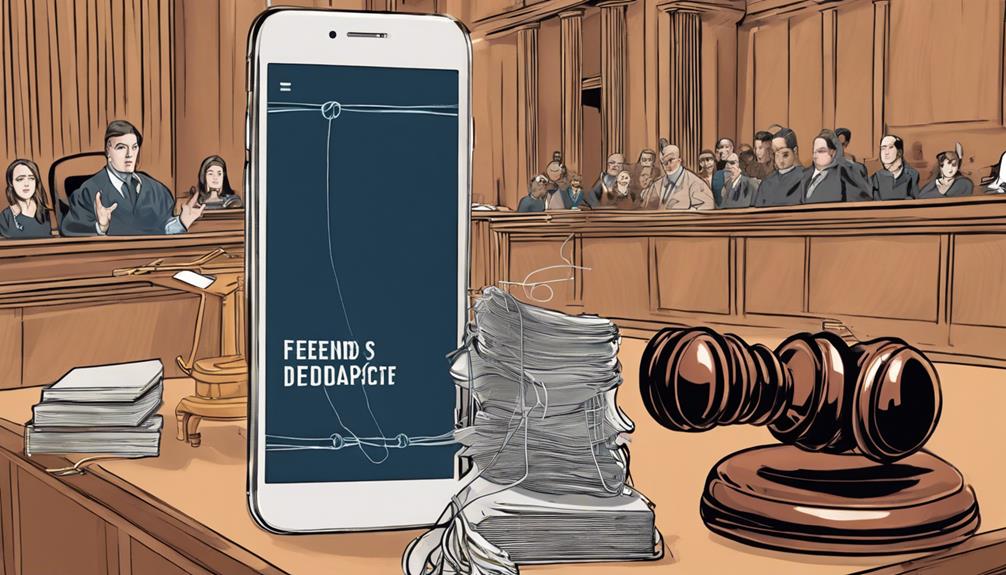
Social media's widespread adoption has given rise to a complex web of legal implications. Employers must navigate workplace gossip, employee activism, and freedom of speech. Defamation and online harassment are rampant, while privacy and data protection concerns abound. Intellectual property infringement risks, online content regulation, and freedom of speech versus censorship dilemmas compound the issues. Cyberbullying and online abuse persist, and businesses face commercial liability. With the legal landscape constantly evolving, it is essential to stay informed about the multifaceted implications of social media use, and to explore the nuanced considerations that underpin this complex and ever-changing landscape.
Employment and Workplace Issues
As the digital landscape continues to reshape the modern workplace, the blurred lines between personal and professional online presence have given rise to a myriad of complex employment and workplace issues. One such issue is the proliferation of workplace gossip, which can spread quickly through social media platforms. What may seem like harmless chatter can escalate into a toxic work environment, leading to decreased productivity, low morale, and even legal consequences. Employers must establish clear policies and guidelines for online communication to mitigate the risks of gossip and rumor-mongering.
Another issue that has gained prominence is employee activism. With the rise of social media, employees are increasingly using online platforms to voice their opinions on workplace issues, company policies, and social causes. While employee activism can be a powerful tool for positive change, it can also blur the lines between personal and professional expression. Employers must navigate the fine line between respecting employees' freedom of speech and protecting the company's reputation and interests. It is essential for employers to develop social media policies that balance employees' rights with the need to maintain a positive and respectful work environment. By establishing clear guidelines and open communication channels, employers can foster a culture of transparency, respect, and trust.
Defamation and Online Harassment
Social media's amplification of online interactions has created a fertile ground for defamation and harassment, where a single tweet or post can spark a firestorm of hate speech, reputational damage, and even legal repercussions. The ease of anonymity and the lack of accountability on social media platforms have emboldened individuals to engage in online insults and defamation, often with devastating consequences for the targeted individuals or organizations.
The legal implications of online harassment and defamation are far-reaching, and reputation management has become a critical component of online presence. A single defamatory statement can spread like wildfire, causing irreparable harm to one's reputation and livelihood. Moreover, the persistence of online content means that harmful statements can linger indefinitely, perpetuating harm and reputational damage.
To mitigate these risks, it is essential to:
- Monitor online presence: Regularly review online content to identify potential defamation or harassment.
- Implement reputation management strategies: Develop a thorough strategy to address online defamation and harassment.
- Foster a culture of online respect: Promote respectful online interactions and condemn hate speech and online harassment.
Privacy and Data Protection
Personal data, once relinquished to social media platforms, can become a prized commodity, vulnerable to exploitation and misuse, highlighting the pressing need for robust privacy and data protection measures. The lack of transparency in data collection and usage practices has sparked concerns about anonymity and the potential for data breaches. Social media platforms must prioritize data encryption to safeguard user information and guarantee that personal data is protected from unauthorized access. Failure to implement stringent security measures could result in severe consequences, including identity theft and financial fraud, further exacerbating users’ concerns. Additionally, the legal implications of data privacy have become a growing area of concern, prompting governments to introduce stricter regulations to ensure accountability in data handling. As awareness increases, users are demanding greater control over their personal information, pushing platforms to adopt more transparent and ethical data policies.
| Privacy Concerns | Data Protection Measures | Legal Implications |
|---|---|---|
| Anonymity concerns | Data encryption | GDPR non-compliance |
| Data breaches | Secure data storage | Financial penalties |
| Unethical data usage | Transparent data policies | Reputation damage |
| Lack of user control | User consent mechanisms | Legal liability |
| Inadequate security | Regular security audits | Compliance with data regulations |
As social media platforms continue to collect and process vast amounts of user data, it is essential to address these privacy and data protection concerns. Implementing robust data protection measures, such as data encryption and secure data storage, can help mitigate the risk of data breaches and ensure compliance with data regulations. Failure to do so can result in significant legal implications, including financial penalties and reputation damage. By prioritizing user privacy and data protection, social media platforms can rebuild trust with their users and maintain a positive online environment.
Intellectual Property Concerns
As social media platforms continue to evolve, intellectual property concerns have become a pressing issue for individuals and businesses alike. The sharing of copyrighted content, misuse of trademarks, and unauthorized image usage can lead to legal repercussions. In this section, we will examine the risks of trademark infringement, the implications of sharing copyrighted content, and the liabilities associated with image usage.
Trademark Infringement Risks
Trademark infringement risks are a significant concern for businesses and individuals alike, as the ease of sharing and accessibility of online content can lead to unintended violations of intellectual property rights. In the social media landscape, it is important to be mindful of trademark infringement, as it can result in legal repercussions and damage to one's reputation.
To mitigate these risks, consider the following:
- Brand Ambassadors: Make sure that brand ambassadors and influencers are aware of trademark guidelines and restrictions when promoting products or services on social media.
- Domain Names: Confirm that domain names used for social media campaigns do not infringe on existing trademarks, and avoid using similar or identical domain names that may cause confusion among consumers.
- Keyword Advertising: Be cautious when using keyword advertising, as it may infringe on competitors' trademarks, and ensure that advertising content does not mislead consumers or create confusion.
Copyrighted Content Sharing
Social media platforms have become breeding grounds for copyright infringement, with users often sharing copyrighted content, such as images, videos, and music, without obtaining the necessary permissions or licenses, thereby safeguarding themselves from legal liabilities. This can lead to legal consequences, including lawsuits and financial penalties.
| Fair Use Exceptions | Social Sharing Norms |
|---|---|
| Giving credit to the original creator | Sharing for personal, non-commercial use |
| Transformative use (e.g., parody, critique) | Sharing for educational or informative purposes |
| Limited, non-substantial use of copyrighted material | Sharing with permission from the copyright holder |
| Use for news reporting or commentary | Sharing under Creative Commons licenses |
| Use for criticism, commentary, or research | Sharing content in the public domain |
When sharing copyrighted content on social media, it is essential to understand the legal implications and adhere to fair use exceptions and social sharing norms. By doing so, users can prevent copyright infringement and ensure they are using copyrighted content legally and responsibly.
Image Usage Liability
Frequently, social media users inadvertently infringe on intellectual property rights by posting copyrighted images without permission, leaving themselves vulnerable to legal repercussions. This carelessness can lead to costly lawsuits, damage to reputation, and even criminal charges. The consequences of image usage liability can be severe, highlighting the importance of understanding intellectual property laws.
To avoid legal issues, it is crucial to understand the basics of image licensing. Here are key considerations:
- Secure necessary permissions: Make sure you have the necessary permissions or licenses to use copyrighted images. This may involve paying royalty fees or obtaining consent from the copyright holder.
- Grasp image licensing terms: Familiarize yourself with the terms and conditions of image licenses, including any restrictions on usage, duration, and territorial limitations.
- Utilize royalty-free images or alternatives: Consider using royalty-free images or alternatives, such as Creative Commons-licensed images, to minimize the risk of copyright infringement.
Online Content Regulation
Governments and regulatory bodies have been grappling with the challenge of balancing free speech with the need to protect citizens from harmful or offensive online content. This delicate balance is essential, as the proliferation of social media has led to an exponential increase in online content, making it increasingly difficult to regulate.
The regulation of online content is a complex issue, with multiple stakeholders involved. On one hand, social media platforms have a responsibility to make sure that their platforms are not used to spread harmful or offensive content. On the other hand, governments and regulatory bodies must ensure that they do not overstep their bounds and violate users' right to free speech.
| Content Moderation Strategies | Algorithmic Transparency |
|---|---|
| Manual Review | Human moderators review content to ensure compliance with community standards |
| Automated Review | AI-powered algorithms detect and remove harmful content |
| Hybrid Approach | Combination of manual and automated review to maintain accuracy |
Effective online content regulation requires a multi-faceted approach, involving both content moderation and algorithmic transparency. By implementing a hybrid approach that combines manual and automated review, social media platforms can make sure that harmful content is removed while minimizing the risk of over-censorship. Additionally, algorithmic transparency is vital in ensuring that users understand how their online experiences are curated and what content is prioritized. By striking a balance between free speech and content regulation, governments and regulatory bodies can create a safer and more responsible online environment.
Freedom of Speech and Censorship
One of the most pressing concerns in the domain of online content regulation is the delicate balance between protecting citizens from harmful content and upholding the fundamental right to freedom of speech. The rise of social media has amplified this concern, as platforms struggle to balance the need to remove harmful content with the need to protect users' freedom of expression.
Censorship and moral policing can often be used as a guise for suppressing dissenting voices, particularly those that challenge dominant ideologies or political correctness. This can lead to a chilling effect on free speech, as users become hesitant to express their opinions for fear of reprisal or censorship.
To strike a balance between these competing interests, it is essential to establish clear guidelines for online content regulation. Here are three key considerations:
- Contextual understanding: Platforms must develop a nuanced understanding of the context in which content is being shared, to avoid misinterpreting or misrepresenting users' intentions.
- Proportionate response: Responses to harmful content must be proportionate to the harm caused, to avoid over-censorship or under-censorship.
- Transparency and accountability: Platforms must be transparent about their content moderation policies and practices, and be held accountable for any abuses of power or biases.
Cyberbullying and Online Abuse
As the online sphere has become an integral part of daily life, cyberbullying and online abuse have emerged as pervasive issues that require urgent attention and effective mitigation strategies. The anonymity of the internet has created an environment where perpetrators can hide behind screens, leaving victims vulnerable and helpless. Anonymous victims often suffer in silence, afraid to speak out against their aggressors, fearing further retaliation.
The lack of accountability and the ease of creating fake profiles have enabled online vigilantes to take matters into their own hands, often exacerbating the problem. In some cases, self-proclaimed online crusaders have taken it upon themselves to exact revenge on alleged perpetrators, further perpetuating the cycle of violence.
The legal system has struggled to keep pace with the rapid evolution of online abuse, leaving victims without adequate recourse. Existing laws and regulations have proven inadequate in addressing the complexity of cyberbullying, and policymakers are still grappling with the challenge of balancing free speech with the need to protect vulnerable individuals.
It is essential to develop and implement comprehensive strategies to combat cyberbullying and online abuse. This includes educating users about online etiquette, promoting digital citizenship, and developing effective reporting mechanisms. Moreover, policymakers must work towards creating legislation that addresses the nuances of online abuse, providing adequate protection for victims and holding perpetrators accountable for their actions.
Business and Commercial Liability
Social media platforms, online marketplaces, and other digital entities are increasingly facing scrutiny for their role in facilitating fraudulent activities, copyright infringement, and data breaches, thereby exposing themselves to significant legal and financial liabilities. As a result, businesses and commercial entities must be mindful of the legal implications of their online presence and take necessary measures to mitigate potential risks.
In the context of commercial contracts, businesses must make certain that their agreements with partners, suppliers, and customers are thorough and legally binding. This includes clearly outlining roles and responsibilities, intellectual property rights, and dispute resolution mechanisms. Additionally, businesses should consider investing in business insurance to protect themselves against potential legal claims and financial losses.
To minimize liability, businesses should:
- Conduct detailed risk assessments to identify potential vulnerabilities and take proactive measures to address them.
- Implement strong cybersecurity measures to prevent data breaches and ensure compliance with data protection regulations.
- Develop robust crisis management plans to respond swiftly and effectively in the event of a crisis or legal issue.
Frequently Asked Questions
Can Social Media Companies Be Held Liable for User-Generated Content?
In the vast expanse of cyberspace, a pressing query echoes: can social media companies be held liable for user-generated content? At the crossroads of platform accountability and content moderation, the answer remains shrouded in uncertainty. As online forums become breeding grounds for misinformation and hate speech, the onus falls on social media giants to police their platforms. The question remains: will they be held accountable for the digital detritus that litters their virtual streets?
Do Social Media Terms of Service Supersede National Laws and Regulations?
Essentially, when examining the relationship between social media terms of service and national laws, a critical question emerges: do these terms supersede national regulations? The answer lies in the complexities of jurisdiction conflicts and regulatory loopholes. Social media companies often operate across borders, creating ambiguity around which laws apply. This ambiguity can lead to regulatory loopholes, allowing companies to exploit differences in jurisdiction, potentially undermining national laws and regulations.
Are Online Impersonation and Identity Theft Criminal Offenses?
Online impersonation and identity theft are criminal offenses that can have severe consequences. These acts can lead to cyber stalking, digital fraud, and financial loss. Perpetrators may face criminal charges, fines, and imprisonment. It is essential to protect personal information and be cautious when sharing sensitive data online. Victims should report such incidents to the authorities, and social media platforms should implement robust security measures to prevent these crimes.
Can Employers Request Access to Employees' Personal Social Media Accounts?
As the curtain of personal freedom draws open, the spotlight shines on a pressing concern: can employers request access to employees' personal social media accounts? This inquiry echoes the age-old debate of privacy rights versus workplace boundaries. While employers may argue that access is necessary for a harmonious work environment, employees contend that their digital lives remain private. The fine line between professional and personal spheres must be delicately navigated to make sure that neither party oversteps their bounds.
Are Social Media Influencers Required to Disclose Sponsored Content?
In the domain of social media, a critical concern arises: are influencers obligated to disclose sponsored content? The answer lies in Federal Regulation, specifically the Federal Trade Commission (FTC) guidelines. Industry Standards dictate that influencers clearly label sponsored posts, ensuring transparency for consumers. Failure to comply may result in legal consequences. Clear disclosure is essential, as it empowers consumers to make informed decisions and maintains the integrity of online advertising.